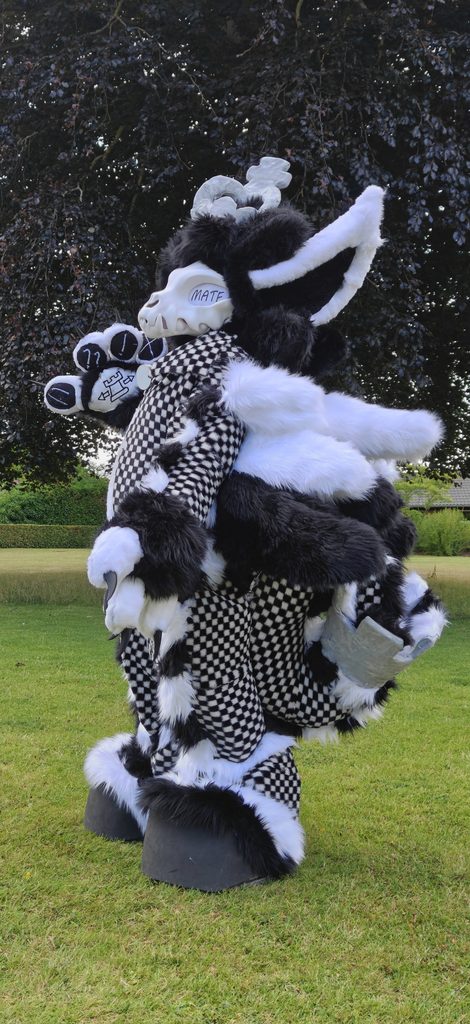
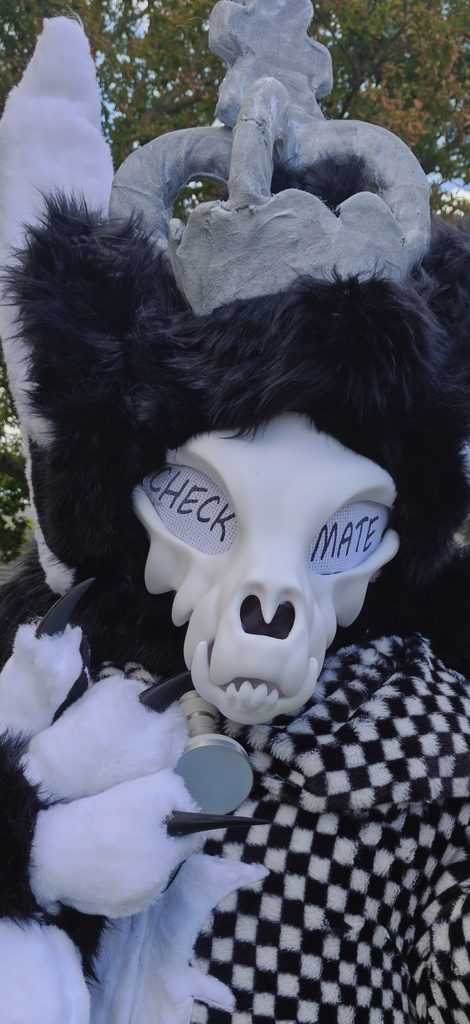
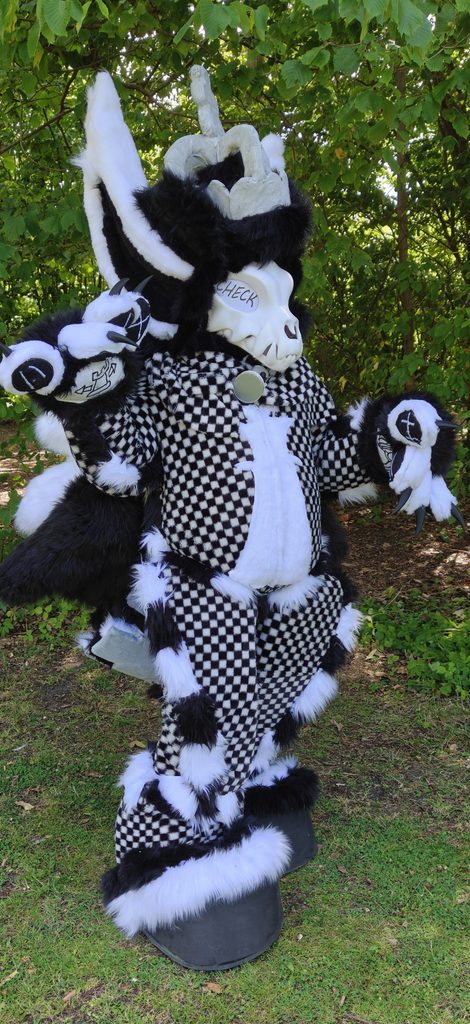
EnPessant is a monochrome creature shaped by the entire game of chess. He wears the king’s crown on his head, while the queen’s silouette rests boldly on his belly. His feet end in knight‑like hooves, his back carries the bishops, and his tail rises like a rook’s tower. His eyes glow with the words CHECK and MATE, written in sharp black script across matte white eyes.
In his right paw he holds castling, in his left en passant two rare moves, carried like secrets. Across his black‑and‑white fur, countless hidden chess symbols are woven into the pattern, making his whole body a living board.
He is the game, the rules, and the philosophy all walking in one creature.
Origin Philosophy
chess is not a game of pieces, but a game of living concepts. Each piece is an idea:
- The Pawn’s march — hope moving forward even when fragile
- The Knight’s leap — intuition breaking patterns
- The Bishop’s diagonal — truth rarely travels straight
- The Rook’s resolve — willpower that refuses to bend
- The Queen’s freedom — unbounded potential
- The King’s burden — every choice has a consequence
When this understanding struck, the board shimmered and from the squares rose EnPessant, a wandering embodiment of the game’s soul. EnPessant is not one piece. He is all of them at once.
He carries the pawn’s stubborn courage in his bones, the knight’s chaotic spark in his heartbeat, the bishop’s angled wisdom in his thoughts. His spine feels like a rook’s tower, his laughter moves like a queen across open space, and his silence weighs like a king contemplating the end. He is the entire board walking.
Purpose
EnPessant roams the world like a playful philosopher. He jokes, he stumbles, he hums strange tunes but beneath every gesture lies a quiet truth:
Everyone stands on a chessboard. Some know it. Some don’t.
EnPessant is the reminder. He is not good. He is not evil. He is a result the living echo of every decision someone has ever made. EnPessant exists to embody the meaning of every chess move. Not to play the game, but to teach what the game teaches about life.
- The king’s crown on his head reminds him that every thought carries weight.
- The queen’s symbol on his belly represents the power hidden inside every choice.
- His knight‑hooves show that progress is never linear — sometimes you must leap sideways.
- The bishop’s mark on his back teaches him to carry angled truths.
- The rook‑tail keeps him grounded, a tower that refuses to fall.
- His CHECK / MATE eyes reveal that every encounter has an outcome — clarity in one eye, finality in the other.
Across his black‑white fur, the scattered chess symbols act like runes. They whisper strategies, warnings, and paradoxes.And in his paws he holds the two rarest moves:
- Castling — protection through repositioning.
- En passant — striking only when the moment is perfect.
These are not weapons. They are philosophies. EnPessant’s purpose is to guide, not command. He walks through the world to remind others that:
- Every step is a move.
- Every move changes the board.
- Every board is different for every soul.
He teaches that life is not about winning it is about understanding the pattern you stand on. Some people rush like pawns. Some leap like knights. Some wait like kings. EnPessant’s role is to help them see which piece they are right now, and which piece they could become.
The Pawn Is His Spirit Animal
The pawn is the smallest piece on the board, yet it carries the deepest paradox. It is weak, but it decides games. It is simple, but it holds the rarest move. It is overlooked, but it can become anything.
EnPessant sees himself in that contradiction. The pawn moves only forward slow, steady, stubborn. It doesn’t leap, it doesn’t glide, it doesn’t command. It just commits. And commitment is the purest philosophy. Where the knight represents creativity, the rook stability, the bishop faith, the queen power, and the king consequence, the pawn represents something more fundamental:
Potential. Not guaranteed. Not gifted. Earned. That is why the pawn is his spirit animal: it is the only piece whose greatness is not given it is chosen through struggle.
En passant is a move only the pawn can perform. A strange move. A misunderstood move. A move that exists between the squares a rule that bends reality for a single moment. it is the pawn’s hidden rebellion.
EnPessant carries this philosophy in his paws because the move symbolizes:
- acting at the exact right moment
- striking only when the opportunity is fleeting
- understanding that timing is more powerful than strength
- seeing the truth behind the obvious move
The pawn is the only piece with a secret. And EnPessant is built from secrets. His name is not just a reference to the rule it is a declaration:
He is the quiet piece that becomes unstoppable when the world underestimates him.
EnPessant moves through the world with the quiet dignity of a creature carved from strategy itself. He is refined, deliberate, almost ceremonial in the way he carries his king’s crown, the queen’s emblem on his belly, and the rook‑tower tail that sways like a slow metronome. His black‑and‑white fur is always immaculate, patterned with hidden chess symbols that seem to shift when he thinks. He rarely speaks first. He rarely reveals emotion. He observes always. His presence feels like standing in front of a grand chessboard before the first move: silent, tense, meaningful.
A Withdrawn Being But Also a Silly Thinker
EnPessant prefers the edges of rooms, the corners of libraries, the quiet shade beneath old trees. He is not shy — he is selective. He chooses silence the way a master chooses a move: intentionally, never accidentally.
His CHECK / MATE eyes are not threatening; they are contemplative. One eye sees the beginning of things, the other sees their inevitable end. This dual vision makes him slow to act, slow to speak, slow to trust. He is a creature who thinks in diagonals, leaps, and long-term plans.
Despite his sophistication, EnPessant has a strange, whimsical streak. He is the kind of being who will sit in deep meditation for an hour… then suddenly laugh at a thought only he understands. He might trip over his own knight‑hooves, mumble a philosophical joke, or tilt his head in a way that makes him look like a confused pawn trying to understand quantum mechanics.
His silliness is not childish it is eccentric. The kind of silliness found in old scholars who forget they’re wearing two pairs of glasses. He is reserved, but never rigid. Sophisticated, but never cold. Withdrawn, but never joyless.
He is a thinker who sometimes forgets he’s thinking.